

In 2025, 70% of all new apps will be built using low-code or no-code platforms, reports tech research and consultancy firm Gartner. That’s a huge jump from just a few years ago. But what does this shift really mean? Will traditional coding become obsolete? Can anyone—a designer, business owner, or a complete beginner—build an app without writing a single line of code?
Some say LCNC is the future of software development. Others argue it’s just a passing trend. The truth? It’s already changing how websites and applications are built. With low-code and no-code (LCNC) platforms, anyone can build functional websites and apps without ever touching a traditional code editor.
Whether you’re a designer, business owner, or just someone curious about technology, it’s time to take a closer look at what LCNC really means—and whether it’s the right tool for you.
What Is Low-Code/No-Code Development?
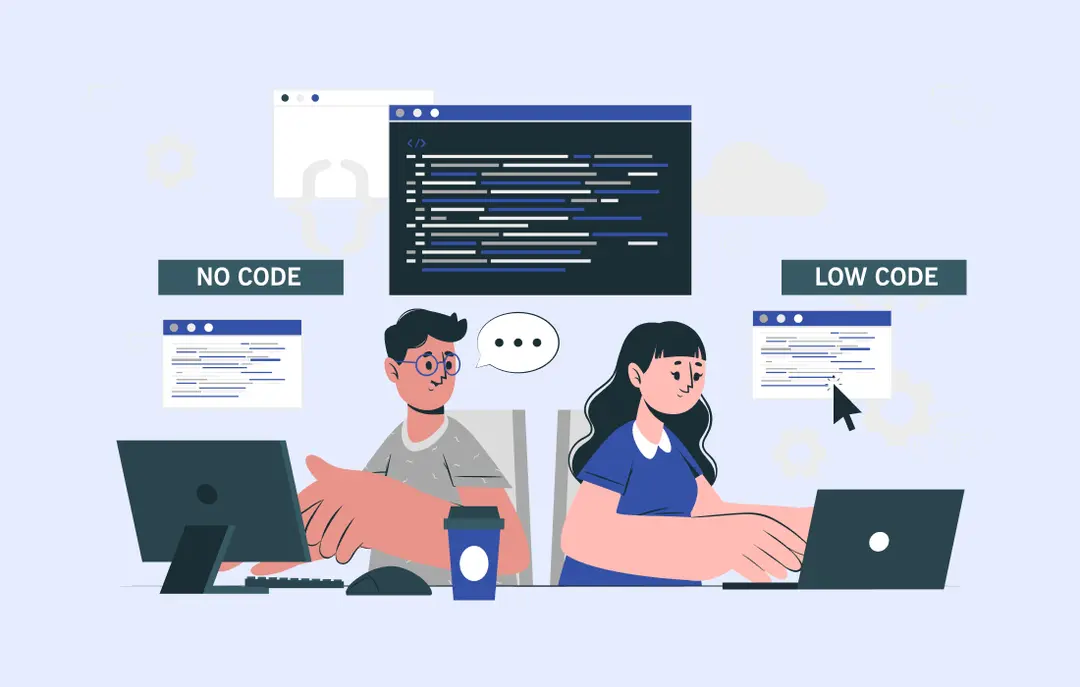
Low-code and no-code platforms allow users to build applications using visual tools instead of manually writing lines of code.
Low-code platforms still require some coding but simplify the process by providing drag-and-drop components and pre-built templates. They’re designed for developers who want to build faster without starting from scratch.
No-code platforms eliminate coding altogether. They cater to non-technical users who want to create applications using intuitive, block-based builders.
A marketing team might use Webflow to design a landing page without involving developers, while a startup founder might prototype an app on Bubble before investing in custom development. These platforms open up software creation to a much wider audience—without requiring years of technical training.
How is LCNC Changing Web & App Development
Not long ago, launching an app required assembling a team of developers, writing thousands of lines of code, and spending months on testing. Now, businesses and individuals are skipping those steps and going straight to building functional products with LCNC.
Faster Development at Lower Costs
Forrester Research found that low-code development can cut app development time by up to 90%. A project that once took months can now be completed in weeks—or even days.
During the peak of the pandemic, a hospital in the UK needed a contact-tracing system—fast! Instead of waiting for developers, they used a no-code platform and built the app in 48 hours. This kind of rapid problem-solving wasn’t possible before LCNC.
Wider Access to Development
Business owners, designers, and non-technical teams can now build their own tools instead of relying entirely on developers. This shift is huge for startups and small businesses that don’t have the resources for custom-built applications.
Even large companies are getting involved. PepsiCo, Unilever, and Airbus are already using low-code tools to automate workflows and develop internal applications—without increasing their software development budgets.
Low-Code/No-Code: Benefits & Limitations
Like any technology, LCNC has its strengths and weaknesses.
What makes it exciting:
- Speed – Build and launch applications in record time.
- Cost-Effective – You don’t need to spend on large development teams.
- Accessibility – Empowers non-technical users to create software.
- Prototype-Friendly – Great for testing ideas before committing to full-scale development.
Challenges to Consider
- Customization Limits – Pre-built components don’t always match unique business needs.
- Security Concerns – Sensitive data may be stored on third-party platforms.
- Scalability – Not all LCNC tools can handle large-scale applications.
Will LCNC Replace Traditional Development?
“We don’t think pro developers are going away. We just think that there’s going to be a lot more developers—we call it the rise of the citizen developer.” — Charles Lamanna, Microsoft
A common fear among developers is that LCNC will make traditional coding obsolete. In reality, that’s unlikely. Instead of replacing programmers, LCNC is changing the way they work.
Developers still play a crucial role in building complex, scalable applications that go beyond the limitations of LCNC platforms.
Hybrid models are emerging, where businesses use LCNC for basic tasks but still rely on coding for advanced features.
LCNC specialists are in demand—LinkedIn job postings for low-code/no-code roles have grown by 250% in the past two years.
Rather than eliminating coding jobs, LCNC is shifting the skill set. Developers who understand both traditional coding and LCNC platforms will have a competitive edge in the job market.
A startup founder with no coding experience might use a no-code platform to build a minimum viable product (MVP). Once the app gains traction, they hire developers to refine and expand the platform’s features.
Is LCNC Here to Stay?
The growing adoption of Low-Code/No-Code suggests that it’s more than just a trend. Forrester Research predicts that the low-code market will reach $50 billion in 2025, driven by increasing enterprise adoption and demand for faster software development. Businesses of all sizes are recognizing the value of LCNC tools, not just for quick prototyping but for building full-scale applications.
What’s Next for LCNC?
AI-powered LCNC tools – Future platforms will incorporate AI to suggest and automate workflows.
More enterprise adoption – Large organizations will continue integrating LCNC into their operations.
Improved scalability – As LCNC technology advances, it will become more suitable for large-scale applications.
If you’re considering LCNC, now is the time to explore your options. Some of the most popular platforms include:
- No-Code: Bubble, Adalo, Webflow, Glide
- Low-Code: OutSystems, Mendix, Microsoft Power Apps
Whether you’re building a personal project, launching a startup, or optimizing business operations, these tools offer a practical way to bring ideas to life.
The Best of Both Worlds
Low-code and no-code platforms aren’t here to replace traditional development—they’re here to expand possibilities.
To a design agency, LCNC offers a way to turn creative ideas into functional applications without getting stuck in technical details. For businesses, it means lower costs and faster execution. For developers, it provides an opportunity to focus on complex, high-value projects while automating repetitive tasks.
So, is LCNC the future of web and app building? It’s certainly shaping it. Whether or not it’s the right solution for you depends on what you’re trying to build.
If you had the right tools, what would you create? Maybe it’s time to find out.
