

The Rise of Philanthropreneurship
The landscape of charitable giving is undergoing a significant transformation as entrepreneurs bring their business expertise into philanthropy. These modern philanthropists, often referred to as “philanthropreneurs,” are using their innovative thinking to create solutions that are both scalable and sustainable. By merging a results-driven mindset with a passion for social change, individuals like Manoj Bhargava are demonstrating how strategic investments in social causes can yield measurable outcomes.
This evolution signals a move away from traditional models of giving, which have historically depended on one-time donations and charitable grants. Instead, today’s leaders are pursuing ventures that produce both societal benefits and financial returns. By treating philanthropy as an investment, these changemakers ensure resources are allocated efficiently, and initiatives become self-sustaining over time.
For example, many philanthropic ventures now deploy business principles such as performance metrics, scalability planning, and targeted impact measurement. This approach is obvious among technology entrepreneurs who have seen firsthand how innovative thinking can disrupt conventional industries. As a result, philanthropreneurship is catalyzing the development of new approaches to tackle entrenched global problems.
The rise of this movement coincides with a broader recognition that lasting social impact requires more than goodwill and sporadic funding. It demands a thoughtful, entrepreneurial approach to problem-solving, with a clear focus on sustainability and the potential to create large-scale change.
Technology’s Role in Modern Philanthropy
Technology is playing a pivotal role in reshaping the philanthropic landscape. Digital tools and platforms now enable nonprofits to expand their reach, tap into new donor networks, and run awareness campaigns with unmatched efficiency. From crowdfunding to blockchain for transparent giving, the digital transformation of philanthropy is allowing for more targeted interventions and better resource tracking. Artificial intelligence is also enabling organizations to analyze data, optimize aid distribution, and measure tangible outcomes, accelerating progress across the sector.
Organizations adopting digital transformation are increasingly able to bridge resources and needs across continents, making the work of solving social challenges more systemic and data-driven. According to The New York Times, many nonprofits are now leveraging advanced algorithms to identify vulnerable communities and deploy aid effectively, unlocking new potential for global-scale impact.
Collaborative Efforts for Greater Impact
To address complex challenges such as poverty, climate change, and public health crises, collaboration across the private, public, and nonprofit sectors is increasingly essential. Partnerships enhance the ability to pilot, scale, and institutionalize promising solutions. When governments provide policy support, businesses contribute capital and operational know-how, and philanthropists absorb early risks, the collective effort accelerates innovation and drives momentum across the social sector.
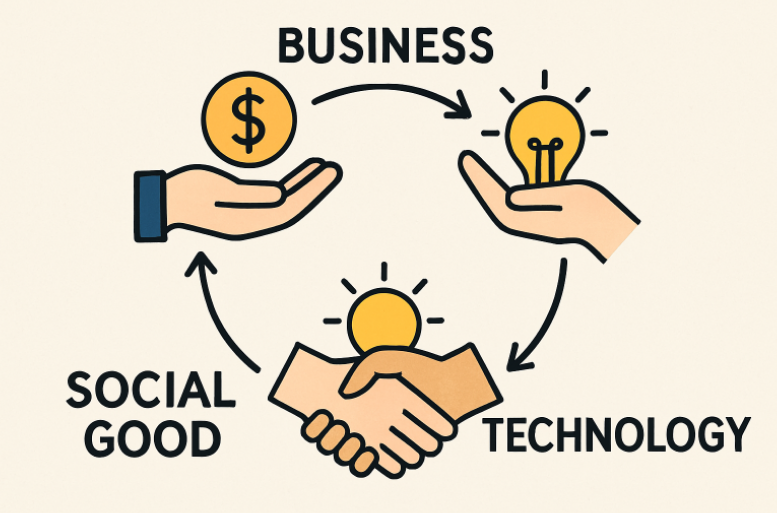
A well-aligned ecosystem, the combination of public policy direction, philanthropic willingness to de-risk initiatives, and the scaling abilities of business, forms a self-reinforcing cycle that benefits society at large. Direct engagement across these spheres creates an environment where successful models are not only developed but also widely adopted, ultimately driving transformative outcomes. The strategic alignment of these efforts has been highlighted as a significant catalyst for tackling systemic challenges by Harvard Business Review.
Case Studies of Innovative Philanthropy
There are numerous examples of individuals and organizations leveraging business tactics for social good:
- Founders Pledge: This initiative empowers entrepreneurs to commit a share of their personal future earnings to social causes. By integrating charitable pledges into entrepreneurial success, Founders Pledge embeds a culture of giving within the technology sector and encourages long-term, impact-oriented commitments.
- Thiel Foundation: Founded by Peter Thiel, the Thiel Foundation supports revolutionary ideas that have the potential to resolve complex issues through innovation. The foundation’s grantmaking extends to early-stage projects that tackle significant societal challenges with unconventional solutions.
Challenges and Considerations
Incorporating business methodologies into philanthropy is not without pitfalls. Entrepreneurs must tread carefully to avoid importing models that are successful in commercial markets but poorly suited to the multifaceted nature of social change. As Jacqueline Novogratz, CEO of Acumen, has warned, assuming that poverty or social inequities can be solved with the same playbook as Silicon Valley startups reflects a misunderstanding of the deep-rooted complexities involved. Solutions must be adaptable, context-sensitive, and designed in partnership with local communities to ensure real, lasting impact.
The Future of Philanthropy
The synthesis of business and philanthropy is still in its early stages, but the trend is only expected to accelerate. As technology continues to evolve and global connectivity brings disparate communities together, the philanthropic sector will increasingly depend on new models that prioritize sustainability and measurable impact. Embracing entrepreneurial thinking and catalytic partnerships will help the industry tackle the large-scale, interconnected issues of the future.
Innovative philanthropy, powered by business acumen and strategic collaboration, may prove to be one of the defining social movements of our time. By drawing on the creativity and rigor of successful enterprises, modern philanthropists are positioned to effect change at unprecedented scale and pace. Their work is not only about giving but also about building robust, resilient systems that can endure and thrive for generations to come.
