

Digital avatars have made their presence felt across social media platforms for a while now. From Facebook to Snapchat and from TikTok to Soul App in China everybody has been allowing users to create a digital representation of themselves. But, the advent of AI has created a frenzy for more realistic 3D renditions of the human personality.
Such is the demand for personalized digital avatars that users, particularly Zoomers, are willing to splurge real money to make their virtual representations look unique. This has turned digital fashion into an industry unto itself.
And that begs the question – But, why bother so much with digital avatars?
For starters, these virtual manifestations are a way for users to show aspects of their personality that go deeper than mere physical. These virtual manifestations can take on a myriad of shapes and forms, which means that there is a lot of scope for creatively displaying emotions, passions, interests, and more without any of it typing back into a user’s real life.
This idea of virtual meets real but without the real-life ripples is in itself alluring enough. But, on a strictly interest-based platform like Soul App that does not allow the use of photographs for profile pictures, these digital personalities turn into a way to establish a first line of communication with other users.
In fact, Soul App is one of the very few social media platforms that have allowed the use of digital avatars from the get-go. This also explains why the company has invested heavily in using AI to power more realistic and accurate onscreen manifestations of the personalities and moods of their users.
Another major player on this scene is Meta and its impetus for pushing 3D avatars comes from founder Mark Zuckerberg’s longstanding vision of popularizing metaverse among Facebook users. In 2022, Meta debuted 3D avatar capabilities on Instagram and hasn’t looked back since.
Soul App jumped on this bandwagon in 2020 with its NAWA and LingXi engines, and the company upped the ante on this front with an upgrade to its large language models that allow for more realistic 3D avatar creation.
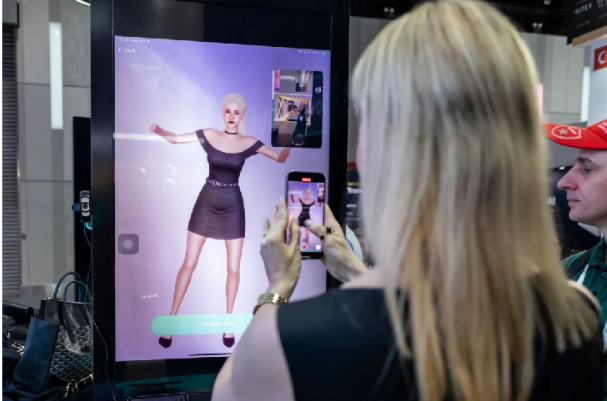
Debuted at GITEX GLOBAL in Dubai, which was held in Oct 2024, this upgrade from Soul App displayed how AI tech can be used to capture personal behavior, user interaction history, and preferences and use this data to create virtual avatars that break the dimensional barrier that inevitably creeps into digital interactions.
Relying on its self-developed large model, which features multimodal understanding, realistic avatars, text and voice conversations, and multilingual support, Soul App provided GITEX GLOBAL attendees the experience of generating 3D virtual avatars in real-time through digital devices. Users had the opportunity to indulge in natural, smooth, and immersive multimodal interactions via real-time motion capture and rendering.
While Soul App and other social media platforms have undoubtedly made significant strides toward enhancing the scope of 3D avatars, social networking is certainly not the only sector tapping into the potential of digital avatars.
Because these virtual manifestations make for nifty digital assistants, brand advertising is another area in which they are being used extensively. For example, both Samsung and Gucci have shown just how effective digital avatars can be in creating and maintaining brand identity and enhancing customer engagement.
The Italian e-commerce platform, Yoox is using digital avatars in a completely different way. This company allows users to create digital avatars that are essentially personalized mannequins that can be used to try out clothes. Known as “Yoox Mirror”, this feature has been a huge hit among the company’s customers as it helps them to make better purchasing decisions.
Other players in the fashion industry have also jumped onto the AI bandwagon with as much gusto; case in point, Calvin Klein’s legendary virtual influencer Lil Miquela. Of course, companies in other sectors are using AI applications just as much to attract younger audiences.
For instance, IBM’s digital avatar Sam offers information in a personalized and emotional way, which encourages greater engagement. There are many other such examples, and why not? The fact is that thanks to these digital avatars powered by AI, companies can now engage with their clients at a deeper level than was ever possible.
Another aspect to consider here is the growing clout of Gen Z consumers who, according to Forbes, display a notable preference for digital-first experiences coupled with a personal touch. For instance, research conducted by Broadridge revealed that 77% of Zoomers are keen on personalized brand interactions.
It’s this demand for greater personalization be it in the service sector or social media platforms that has served as an impetus for companies like Soul App to continue to build their AI capabilities and use them to power unique and creative use cases.
Also, the idea of 3D avatars sits particularly well with Soul App’s core concept of allowing people to interact in a digital space while still holding on to self-value expression. Plus, these customized digital personalities enable users to don many hats and to put various shades of their personality in the spotlight to suit specific scenarios.
While avatars used in lieu of profile pictures offer a host of benefits, 3D avatars that promise animation and visual realism bring extra dollops of fun and fulfillment to digital interactions. According to a recent study, avatars that display natural movements enhance the enjoyment of digital interactions.
This was another reason for Soul to continue working on improving the “Digital Twin” feature. For the platform’s presentation at GITEX GLOBAL, the Soul team used monocular cameras to accurately capture user body language and facial expressions. A sophisticated machine learning algorithm was then used to make this data comprehensible to the 3D avatars and enable them to reflect these movements in real-time.
The idea all along was to create an environment where digital interactions feel as real and as close to face-to-face interactions as possible. At this time, Soul App’s NAWA engine is capable of picking up and displaying 90 facial parameters and six attribute/personality parameters.
But, the team behind Soul has no intentions of stopping at this! In essence, as was the case earlier, social media platforms like Soul App are definitely leading the charge when it comes to developing technologies that can enhance the ability to create more realistic and effective 3D avatars.
The CTO of Soul App, Tao Ming said it best when he summarized that social networking, as a natural traffic hub and interaction gateway, is one of the best scenarios for AI to land. This explains why Soul’s team has promised to continue working on and investing in AI technologies to meet the real social needs of users and to bring long-term, sustainable value.
