

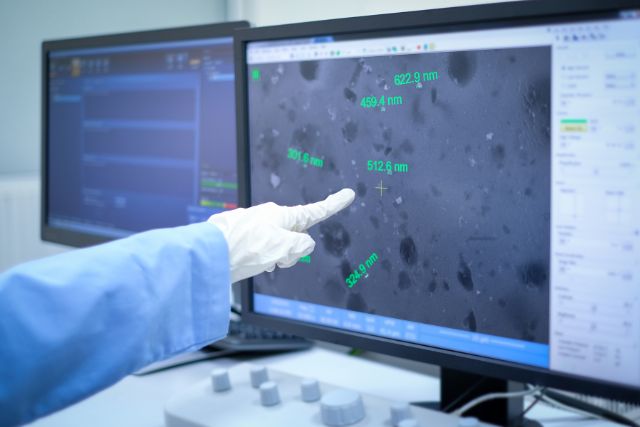
Material analysis drives scientific and industrial growth. Scanning Electron Microscopy (SEM) is a key tool for material analysis. SEM defines a unique image potential and enables atomic-level analysis of materials. This blog explores the method and importance of SEM in material testing.
Contents
What is Scanning Electron Microscopy (SEM)?
SEM is a modern imaging technique that uses a focused electron beam to scan a sample’s surface. Unlike light microscopy, SEM uses electrons for higher resolutions, making it essential for testing fine materials.
History and Evolution of SEM
German physicist Manfred von Ardenne’s work discovered the SEM method in 1930. The technology made SEM accessible in the 1960s. Due to its widespread fame, it started to be used in academia and industry.
ESEM is a modern way of using SEMs that can image wet or non-conductive samples, expanding their use. Advanced detectors immediately support geological images and compositional data, improving SEM’s utility.
How SEM Differs from Other Microscopy Techniques
Scanning electron Microscopy is better than optical microscopy. It has a higher resolution and shows three-dimensional views of a sample’s surface—the wavelength of light limits optical microscopy. SEM’s higher intensity of field gives a more detailed view. It can resolve features as small as a few nanometers.
How SEM Works
Electron Beam Generation
SEM uses an electron gun to produce a focused electron beam. It directs the beam at the sample using electromagnetic lenses. Scientists know SEM for its detailed images. They come from the interplay of electrons and the sample.
Interaction of Electrons with Sample
The power beam hits the sample’s atoms, emitting secondary and backscattered electrons and X-rays. We find and treat these signals, which form high-resolution images of the sample’s surface.
Detection and Imaging Process
Detectors collect emitted signals and convert them into electrical signals, creating specific images. The quality of the figure depends on the detector type and electron beam strength.
Applications of SEM in Material Analysis
Material Composition Analysis
SEM, with Energy-Dispersive X-ray Spectroscopy (EDS), quantifies elements in a sample, making it great for material composition analysis.
Surface Morphology Study
SEM can reveal surface coarseness, grain size, and texture, which is key in industries such as coatings and thin films.
Crystallography and Grain Structure
EBSD can analyze phase distribution and grain structure, and SEM can adjust the pieces. These are crucial for understanding material properties.
Advantages of SEM in Material Analysis
High Resolution and Magnification
SEM can magnify objects up to 100,000 times, and its resolution is better than that of ocular microscopy. It allows for detailed microstructure analysis.
3D Imaging Capabilities
SEM creates 3D surface images. This gives a complete view of a material’s morphology.
Versatility in Analyzing Various Materials
SEM is versatile, and it helps analyze metals, ceramics, polymers, and biological specimens. This makes it essential in both research and industry.
SEM in Industrial Applications
Role in Quality Control and Assurance
Industries like manufacturing and aerospace rely on SEM for quality control. It detects defects and ensures material consistency.
Use in Failure Analysis
SEM is vital in failure analysis. It helps engineers find the causes of material failures and predicts future material performance.
Applications in the semiconductor industry
The semiconductor industry uses SEM to check and fix microelectronic devices. This ensures that their components are intact.
Scanning electron microscopy (SEM) is a key tool for material analysis. It offers original insights into the microscopic world. Its development and comprehensive applications in research and manufacturing emphasize its significance. As technology advances, SEM’s abilities will grow, strengthening its role in material analysis.
