

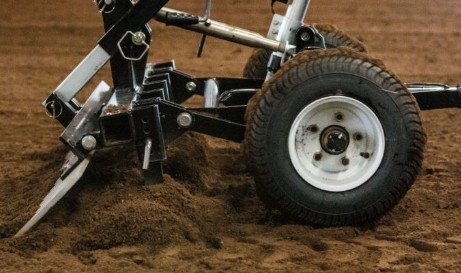
The cheapest blade on the invoice is usually the most expensive thing in the arena. That reads backwards until you total up what a rounded-over edge does to a base you already paid somebody to build, grade and compact. Owners of small covered arenas drag their footing every week, and once the soft blade quits slicing, carbon grader blades start coming up in every conversation about footing that will not stay level. The argument is simple. A blade that holds a defined bevel at a set depth levels the footing, while a blade that has gone round pushes material, floats over the hard spots and then drops into the base without warning.
Soft Steel Rounds Off And Starts Gouging
A fresh edge cuts the compacted top layer at a fixed depth, which is the entire point of dragging in the first place. Then the corner wears. A crisp line becomes a radius, and once that radius is wide enough the blade stops cutting and starts riding along the surface until it catches a soft spot and dives. What we see most often in an arena that somehow has hard patches and loose dust within the same thirty feet is not a drag problem at all. It is an edge that rounded over months ago while nobody was looking at it.
Blade steel is not a commodity, and neither is the shop that shapes it. Heat treatment, bevel angle control and dimensional checks partway through a production run are all skilled labor, and that labor is getting harder to hire: ARC Labs reported in March 2026 that the American Welding Society projects a need for 336,000 new welding professionals by 2026 to replace retiring workers and keep up with demand. Two blades with identical dimensions on paper can behave nothing alike in the dirt for exactly that reason. You are buying a process, not a bar of steel with holes punched in it.
If your drag is leaving dust on top and hard pan underneath in the same pass, suspect the blade before you touch anything else. If the bevel still looks crisp under a straightedge and the problem persists, then look at moisture and drag depth instead. Honestly, nobody publishes a trustworthy number for how many hours a mild-steel edge survives in arena sand before it rounds; the loads vary too much and no one appears to be tracking it. I went looking for that figure and came back empty, which is its own kind of answer about how these blades get sold.
Questions To Put To A Blade Supplier
Most of the money goes wrong at the order, not in the arena. A fabricator who actually forms and heat-treats edges can answer each of these in a sentence, while a reseller reading off a catalog page will stall. Ask about heat treatment and bevel angle before you ask about price per foot. Write the answers down, because a year from now you will want to know which spec held and which one did not.
- How hard is this steel after heat treatment? A good answer names a Brinell or Rockwell number instead of saying it is hardened.
- Is the bevel angle held to a spec through the whole run, and how do you verify it? A good answer describes checks on finished pieces, not just on the first one off the line.
- What thickness and width do you recommend for a light arena drag, and why that one? A good answer asks about footing depth and drag weight before naming a size.
- Can I buy this in a longer length or as barstock, and what does that change per foot? A good answer gives a real figure and a lead time.
Those four questions sort suppliers quickly. A shop that controls bevel formation and verifies dimensions during the run will volunteer it without being pushed, and it will also tell you plainly when its steel is the wrong pick for what you are cutting. That second half is the part worth waiting for. Anyone who answers every question with yes is selling you the same mild plate the last guy did.
Match The Steel To The Footing Not The Price
Say the arena runs on a $6,000 annual footing budget, which is roughly what a 200 by 100 covered ring in central Texas absorbs in sand, water and labor. Two bargain blades a year look like a rounding error against that number. The repair does not: once the base is gouged you are buying material, a grading pass and a week with no lessons on the calendar, and the arena keeps the receipts. July dust season is when owners notice, because that is when the loose top and the hard pan stop hiding from each other.
Buy the edge to match what you are cutting, then check it monthly with a straightedge and keep a spare on the shelf. Compacted sand and fines under a covered roof want a hardened single-bevel edge that holds its cutting line at a set depth, and carbon grader blades in the three-eighths to five-eighths inch range are the usual pick for a light drag on an arena that size. Swapping an edge for a couple hundred dollars beats resurfacing for several thousand, every single season. Price per foot is the worst possible way to decide what the base under your footing is worth.
