

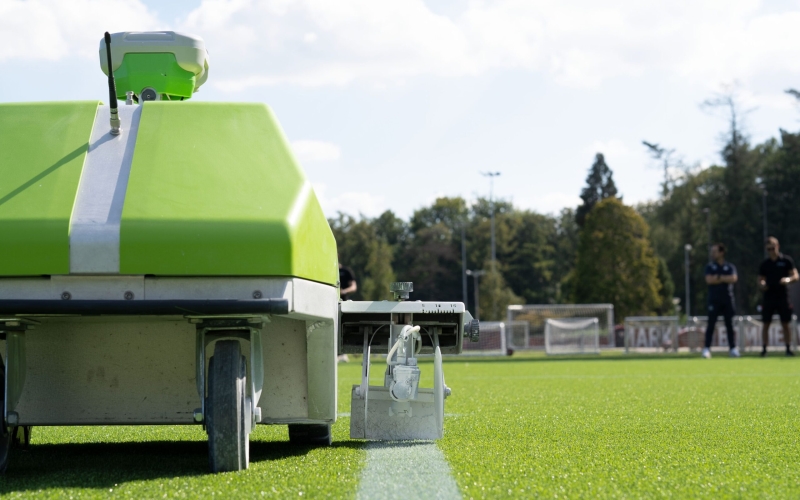
In the world of sports, precision is paramount. From the lines on a tennis court to the boundaries of a soccer field, accurate automated field markings are crucial for fair play and the integrity of the game. Traditionally, marking these fields has been a labor-intensive task, reliant on manual labor and prone to human error. However, advancements in smart robotics are revolutionizing this process, offering a blend of precision, efficiency, and innovation that is transforming the sports industry.
The Importance of Accurate Field Markings
Accurate field markings are essential for several reasons. First, they ensure that the game is played according to official regulations, maintaining consistency across different venues and events. Incorrect markings can lead to disputes, affect player performance, and even alter the outcome of a match. For instance, a misplaced boundary line in cricket or a skewed goal area in soccer can create significant disadvantages for teams.
The Traditional Approach: Limitations and Challenges
Historically, field markings have been applied using manual or semi-automatic methods. Groundskeepers use measuring tapes, chalk, string lines, and stencils to outline fields. While these methods can achieve a reasonable degree of accuracy, they are time-consuming and labour intensive. Human error is a significant drawback, leading to inconsistencies that may not be immediately apparent but can have substantial implications during a game.
Enter Smart Robotics: Precision and Efficiency
Smart robotics offers a transformative solution to these challenges. Leveraging advanced technologies such as GPS, artificial intelligence (AI), and computer vision, robotic field marking systems can achieve unprecedented levels of accuracy and consistency.
GPS and Mapping Technology
Modern robotic marking systems utilize high-precision GPS technology to map out the exact dimensions and layout of a sports field. These robots are equipped with GPS receivers that can pinpoint their location with centimeter-level accuracy. By following pre-programmed coordinates, the robots can mark out fields with remarkable precision, ensuring that every line is exactly where it needs to be.
This technology is particularly beneficial for sports that require highly specific measurements, such as tennis, where the width of lines can impact the game significantly. For larger fields like soccer or rugby, GPS-guided robots can cover extensive areas efficiently, reducing the time required for marking and ensuring uniformity across different fields.
Artificial Intelligence and Machine Learning
AI and machine learning algorithms enhance the capabilities of robotic field markers. These systems can learn from previous marking tasks, continuously improving their accuracy and efficiency. For example, AI can optimize the robot’s path to minimize overlaps and gaps, ensuring that lines are straight and corners are sharp.
Additionally, AI can analyze field conditions and adapt the marking process accordingly. If the field has uneven terrain or obstacles, the robot can adjust its route and marking technique to maintain accuracy. This adaptability is crucial for maintaining high standards in varying environments.
Benefits Beyond Accuracy
The adoption of smart robotics for sports field markings offers several benefits that extend well beyond just improved accuracy. These systems can significantly reduce both the time and labor that is required for marking, which can ultimately free up groundskeepers to focus on other essential maintenance tasks. This efficiency can lead to cost savings for sports organizations and facilities, which makes it a financially viable investment.
In addition to that, robotic marking systems are great for the environment. Traditional methods will often involve repeated applications of paint or chalk, which can have negative environmental impacts. Robots can use eco-friendly materials more efficiently, reducing waste and minimizing the ecological footprint of sports field maintenance.
Future Prospects and Innovations
The future of smart robotics in sports field markings is promising. As technology continues to advance, we can expect even greater levels of precision and automation. Innovations such as autonomous drones for aerial field mapping and advanced AI algorithms for predictive maintenance are on the horizon, further enhancing the capabilities of robotic systems.
In conclusion, the integration of smart robotics into sports field marking processes represents a significant leap forward in precision, efficiency, and innovation. By harnessing the power of GPS, AI, and computer vision, these systems ensure that sports fields are marked accurately and consistently, contributing to the fairness and integrity of the game. As technology continues to evolve, the possibilities for further improvements are limitless, heralding a new era in sports field maintenance.
